If you’re manufacturing in Korea for the first time, pricing can feel slippery. You ask for a unit cost, and the first answer is often a range, a “ballpark,” or a request for more details. In Korean cosmetic manufacturing, that’s not a sales tactic—it’s how pricing works when the inputs that create cost aren’t fixed yet.
In K-Beauty manufacturing, unit cost is the result of choices. Once you learn the three main cost drivers—and the questions manufacturers are silently waiting for you to answer—pricing becomes predictable and trade-offs become intentional.
Why Manufacturers Can’t Give Exact Pricing Upfront
A precise unit cost requires a precise spec. Early on, most projects don’t have one: formula direction is still moving, packaging is not finalized, decoration options are undecided, and quantity per SKU is often unclear. Without those inputs, manufacturers cannot confidently price materials, procurement timelines, and production steps.
That’s why ballpark ranges are common at the start. The purpose is to align on a realistic cost band while you finalize the variables that actually determine the final number. As your Product Brief becomes more specific, the quote becomes more accurate.
The 3 Cost Drivers That Shape Unit Cost in Korea
Cost Driver #1 — MOQ & First Production Volume (Where Most First-Time Assumptions Break)
Many first-time brands carry two assumptions: “If we pay, any factory will produce any quantity,” and “Smaller first orders reduce risk.” In Korea, both can be misleading, especially if you want to work with top-tier manufacturers.
First, define the basics clearly:
- SKU (Stock Keeping Unit): one distinct product or option (e.g., foam cleanser + gel cleanser = 2 SKUs; lipstick in 4 shades = 4 SKUs).
- MOQ (Minimum Order Quantity): the minimum the factory requires per SKU, not per project.
Why small MOQs can increase risk (not reduce it):
- Top Korean manufacturers are often fully booked with large global brands, which means small MOQs may be hard to accept or easy to deprioritize when production slots are tight.
- Smaller runs tend to have higher per-unit cost due to line setup, component procurement, and packaging minimums that don’t scale down cleanly.
- When volume is small, your project may slip in scheduling priority, which can increase lead-time risk—sometimes more than brands expect.
A more realistic way to set your starting volume:
- Start from your real constraints: budget, how many SKUs you truly need at launch, and how likely reorders are.
- Choose a volume band where factory acceptance, unit cost, and timeline are all realistic—rather than optimizing only for the smallest possible MOQ.
- Treat the first run as building a stable relationship with a manufacturer, not just minimizing exposure.
Cost Driver #2 — Formulation & Ingredients (Formula Choices Connect to Regulation, Testing, and Cost)
Formulation is not just “choosing ingredients.” In manufacturing terms, formulation direction connects directly to your launch market’s regulatory constraints, your testing/clinical plan, and your cost structure. If you clarify formulation direction early, ballpark pricing becomes easier, and regulatory/testing planning becomes more proactive.
Promotional ingredients: concentration matters more than the name. Brands often ask, “Can we include this ingredient?” but manufacturers think, “At what concentration?” Because at meaningful levels, cost impact is driven by dosage, not label mention. If you’re pursuing performance claims or measurable results, you typically need an ingredient system designed to support that outcome, not just a trending ingredient added at a symbolic level.
Key formulation cost levers:
- Promotional ingredients: unit cost is often driven by concentration, especially when tied to performance claims.
- Claims and testing: if you want claims like hydration increase %, brightening, wrinkle improvement, vegan positioning, or other certifications, the formula may need to be designed to support the testing and documentation required.
- Ingredients to avoid: removing preservatives or other components can force more expensive substitutes or added stability considerations.
Fragrance: where cost, regulation, and labeling collide
Fragrance is one of the most underestimated cost and complexity drivers in first-time projects. Many brands assume “natural fragrance is better,” but from a producer standpoint, natural fragrance can bring along unwanted allergen components that increase allergy risk and labeling complexity. In some cases, a well-designed synthetic fragrance can allow tighter control over allergen composition, even if it changes what you can claim on the label.
A practical fragrance framework:
- Natural fragrance: can include naturally occurring allergens, which may increase allergen/labeling risk depending on market requirements.
- Synthetic fragrance: can be engineered for more controlled compositions (including allergen-reduced design), but you cannot claim “fragrance-free” if fragrance is used.
- Fragrance level (low/medium/high): directly changes fragrance usage and cost, and can affect how consumers perceive the product experience.
Cost Driver #3 — Packaging & Decoration (Customization Can Move Cost More Than Formula)
Even with the same formula, unit cost can vary widely based on packaging and decoration choices. Packaging is not “just design”; it is a manufacturing spec that affects component cost, procurement time, production complexity, and sometimes compatibility testing requirements.
Key packaging elements you can customize:
- Container type, volume, and material: tube, bottle, pump, dropper; structure, size, and material selection.
- Cap/pump/dropper components: inner parts, gaskets, and dispensing structures that can raise cost quickly.
- Printing method: direct printing vs labeling, and the number of colors used.
- Decoration/finishing: coating, matte/gloss, foil stamping, embossing, and other premium treatments.
- Unit carton structure and finish: carton shape, paper quality, coating/foil/emboss choices.
- Export packing units: how the product is packed from unit carton → master carton → pallet for shipping stability.
How packaging choices typically affect cost:
- The more you customize the container, printing, and finishing, the more the packaging unit cost rises.
- Many brands start with a rough “customization level,” then adjust details during quotation to hit the target cost band.
- Packaging choices can also affect lead time, because some components have longer procurement windows and some formula-container combinations require validation through CT testing.
What’s Inside a Typical Unit Cost Breakdown
Quotes differ by manufacturer, but the building blocks are consistent. When you map these line items back to the three cost drivers, the quote becomes readable instead of mysterious.
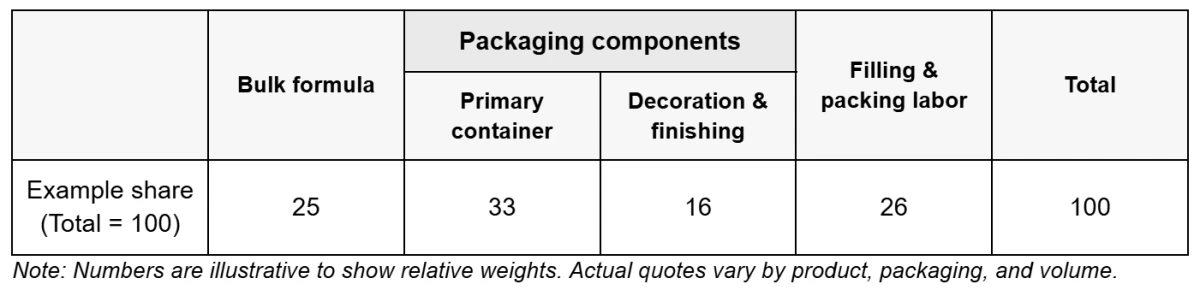
Typical unit-cost components:
- Unit container (tube/bottle/jar/pump system)
- Inner parts (pump internals, droppers, gaskets)
- Decoration (printing and finishing processes)
- Unit carton and label
- Bulk formulation (the product itself)
- Filling and packing labor
- Sometimes: export cartons/pallet packing structure, one-time tooling/mold costs
FAQ — “Do You Have a Formulation Catalog We Can Choose From?”
This is a common question, and the honest answer is that a fixed catalog is not realistic in modern NPD. Every year, manufacturers, labs, and raw material suppliers release new systems, ingredients, and textures at a pace that makes any static list outdated immediately. Even if a catalog existed, it would be too large for brands to evaluate in a meaningful way.
The faster and more effective approach is: use your Product Brief, market/trend inputs (like a K-Beauty report), and benchmark products to narrow the direction, then select a small set of best-fit formulations to test. From there, you customize by adding what you want, removing what you don’t, and refining through sampling rounds until the formula matches the target.
Conclusion
In Korean cosmetic manufacturing, unit cost is mainly built by three decisions: MOQ per SKU and first production volume, formulation direction (linked to regulation/testing and ingredient concentration, including fragrance design), and packaging/decoration customization (container structure, printing, finishing, and export packing design). The fastest way to get accurate pricing is to define these inputs early, then discuss trade-offs through the three drivers instead of asking for a single number too soon.